
Marine Affairs and Port Management
Prepare for leadership in ports and maritime industries by mastering the management, governance, and operations of complex coastal systems.
The Bachelor of Science (BSc) in Marine Affairs and Port Management prepares graduates for supervisory and management roles in port authorities, terminal operators, maritime service providers, and public-sector agencies that influence coastal and maritime activities.
The program considers ports as regulated, safetycritical, and environmentally important systems that require managerial judgment in governance, compliance, and operations. It is intentionally not a logistics-focused degree.
Apply management and organizational principles to port and maritime service environments, including planning, staffing, coordination, and performance improvement.
Analyze port, coastal, and marine governance structures and stakeholder ecosystems (public agencies, private operators, communities) and propose coordination strategies aligned to legal, institutional, and cultural constraints.
Interpret and apply maritime law and ocean policy frameworks to operational, planning, and development decisions, including compliance documentation, permitting logic, and risk mitigation.
Evaluate marine environmental and resource-management obligations relevant to ports and coastal operations, including impact analysis, monitoring, reporting, and mitigation planning.
Explain core port and terminal operational systems and recommend operational improvements based on process analysis and data-informed reasoning.
Assess trade-facilitation workflows (documentation, controls, information flows) and recommend improvements that strengthen efficiency, transparency, and compliance integrity.
Produce professional, evidence-based written and oral deliverables (briefs, analyses, presentations) suitable for executive and multi-stakeholder audiences.
Synthesize program learning through WBL Studio artifacts and an integrated capstone that demonstrates applied leadership, including at least one policy or governance deliverable and an implementation-ready management product.
Port Operations / Terminal Operations Coordinator or Supervisor
Port Authority / Port Services Coordinator
Maritime Agency / Documentation and Vessel Call Coordinator
Governance, Risk & Compliance Coordinator (Port/Maritime)
Environmental Compliance / Sustainability Coordinator (Port/Coastal)
Port Performance Analyst / Operations Improvement Analyst
Trade Facilitation / Customs-Adjacent Process Coordinator
10 Semesters
Semester 1 (13 Credits)
Semester 2 (13 Credits)
Semester 3 (14 Credits)
Semester 4 (14 Credits)
Semester 5 (15 Credits)
Semester 6 (12 Credits)
Semester 7 (11 Credits)
Semester 8 (10 Credits)
Semester 9 (12 Credits)
Semester 10 (9 Credits)
AUI Global welcomes applications from motivated Moroccan students ready to earn the University bachelor's degree through a work-integrated, hands-on learning experience. Admission is competitive and open to students based in our active regions
Applicants must hold a Moroccan baccalaureate or equivalent qualification and be based in one of the two active regions: the Oriental Region, or Dakhla-Oued Eddahab.
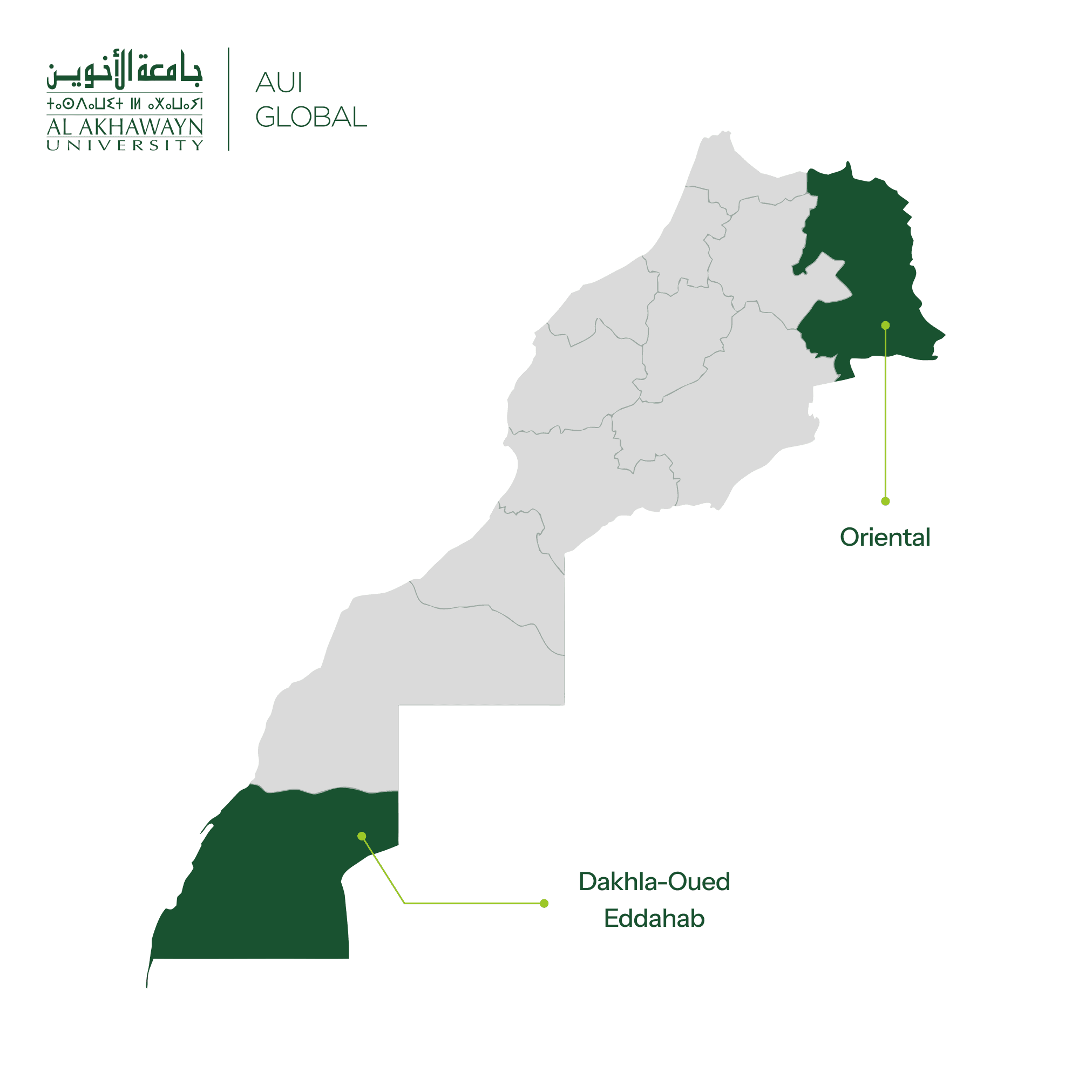
Admission is based on academic record and fit with the Work-Based Learning model and available sectors. Additional regions will be added in the future.

Work-Based Learning (WBL) Studio
WBL Studio is a credit-bearing, progressive learning experience embedded across the AUI Global undergraduate degree programs. WBL Studio carries 10 academic credits toward the degree and unfolds across the program with increasing complexity, deeper integration with the major, and greater student independence as students advance. Workplace activity provides the context for learning, and AUI awards academic credit only for assessed academic work.
Capstone
Each AUI Global undergraduate degree includes a culminating academic assessment, the Capstone Project, which evaluates students' achievement of the program's learning outcomes. The Capstone Project serves as the final integrative component of the curriculum and provides a comprehensive demonstration of student learning. Students synthesize knowledge and skills from coursework and Work-Based Learning (WBL) Studio experiences.

Key dates and deadlines for the academic year
Not Sure Which Degree Is Right for You?
Not everyone starts with a clear career path. This quick assessment helps identify the programs most aligned with your ambitions and preferred way of working.

How long will it take to complete a degree?
How long is a semester?
How many credits will I take per semester?
What academic support services are available to AUI Global students?
Will support be more intensive in the first year?
Can AUI Global use consortium or partner courses?
How are partner courses approved?
Will any outside course automatically count?
Are there restrictions on major-core or graduate-level online transfer?

Ready to Discover Your Career(s)?
Your future is within reach. Start now by requesting information or applying.